
The 2026 Reality: Leads Are Easier to Buy Than Ever, But Occupancy Still Gets Lost After the Lead
In property management, marketing success is often framed around one question: “How many leads did we get?”
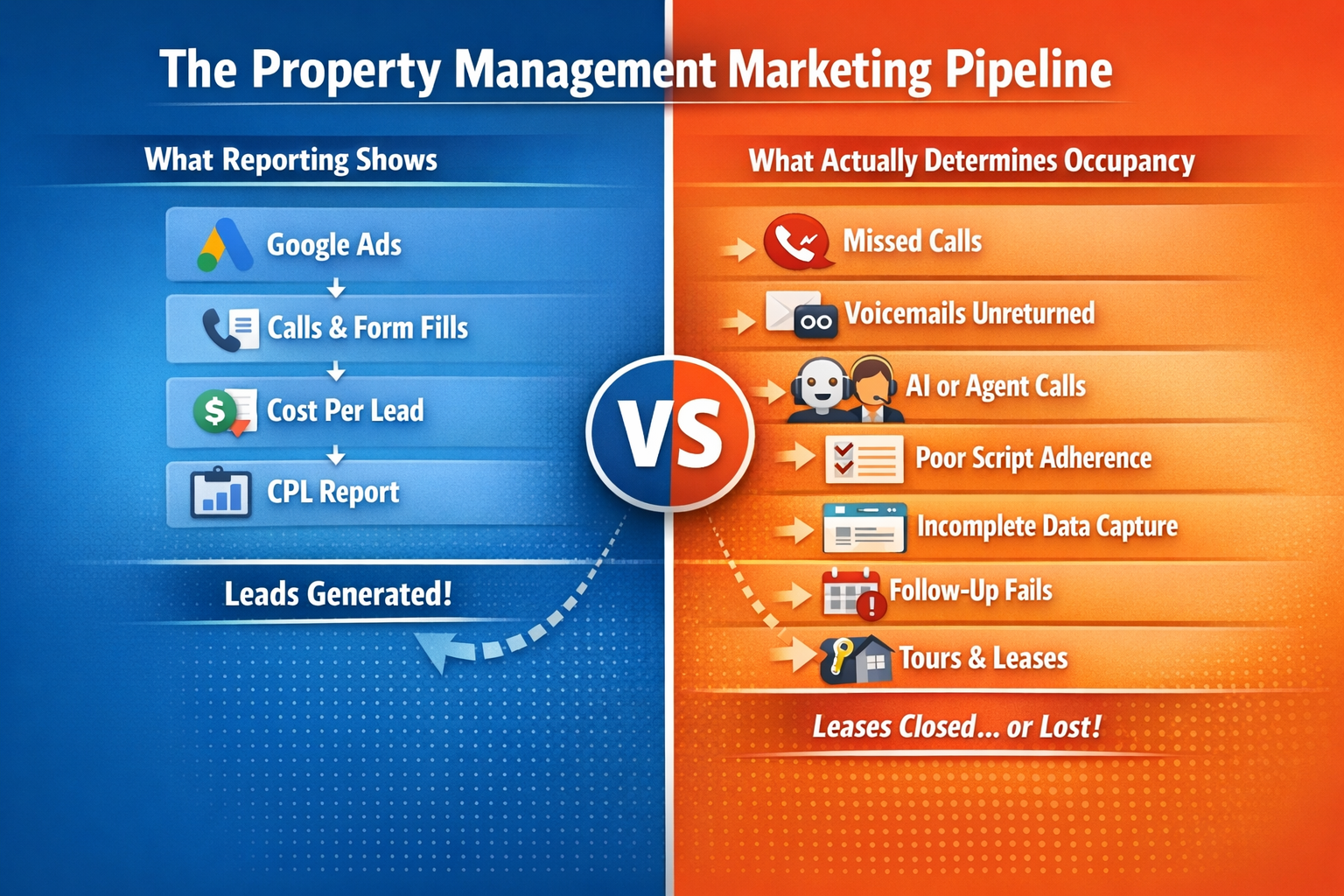
Google Ads dashboards show calls, form fills, cost per lead, and cost per call. On paper, everything looks productive. Budgets are being spent. Phones are ringing. Lead volume appears healthy.
And yet—occupancy targets are missed. Leasing velocity stalls. Revenue doesn’t line up with expectations.
The uncomfortable truth is this: Most property management companies only understand the first half of their marketing pipeline.
And in 2026, this gap is widening. It’s never been easier to “buy” solutions—AI agents, chatbots, call routing, automation workflows—and assume the problem is solved. But AI is a tool, not a replacement. If it’s implemented without oversight, training, measurement, and operational alignment, it can simply shift (or amplify) the leakage that already exists.
The Pipeline Property Management Teams Think They’re Managing
For many operators, the pipeline looks something like this:
- Google Ads or paid media drives traffic
- A prospect calls or submits a form
- The lead is logged
- Marketing performance is evaluated
Once a call or form is recorded, the system assumes the opportunity was “handled.”
In reality, that’s where the most important work begins.
The Marketing Pipeline That Actually Drives Occupancy
In call-driven industries like multifamily, the real pipeline looks very different:
- Paid media captures renter intent
- A call connects—or doesn’t
- The call is answered, missed, routed incorrectly, or sent to voicemail
- A human or AI agent handles the conversation
- Leasing scripts are followed—or skipped
- Critical renter information is captured—or missed
- Next steps are clearly explained—or vague
- Follow-up workflows are triggered—or never start
- A tour is scheduled—or the opportunity dies
Most revenue loss in property management happens after the lead is already paid for.
The Silent Revenue Killers in Property Management
1) Missed Calls Aren’t “Bad Leads”
Missed calls during leasing hours are not low-quality demand. They are paid renter intent that never spoke to your team.
A 15–20% missed call rate is common across many portfolios—and devastating to occupancy math.
2) AI-Handled Calls That Create Friction
AI call handling can scale coverage, but poorly designed flows introduce new problems:
- Over-qualification before value is established
- Inability to handle urgency (“I need to move next week”)
- No clean escalation to a human
- Repetitive loops that frustrate callers
From a report, these look like “handled calls.” From the renter’s perspective, they feel like dead ends.
The key point for 2026: buying an AI agent does not finish the job. AI needs clear goals, guardrails, QA, escalation logic, training feedback loops, and performance measurement—just like a human team.
3) Voicemails That Quietly Kill High-Intent Demand
Anyone willing to leave a voicemail is highly motivated. Yet many properties:
- Don’t track voicemail volume
- Don’t track callback time
- Don’t track callback outcomes
A voicemail returned 24–48 hours later often results in no conversation at all. The renter has already called another property.
The Occupancy Math Most Property Managers Never See
Missed calls and broken follow-up are not abstract problems—they translate directly into lost leases and lost NOI.
A Conservative, Realistic Scenario
- 300 inbound calls per month from paid media
- 20% missed call rate
- 60 missed calls
Assume:
- 35% of answered calls convert to tours
- 30% of tours convert to leases
That results in:
- ~21 missed tours
- ~6–7 lost leases per month
At an average rent of $1,900:
- ~$13,300 in lost monthly revenue
- ~$159,600 in annual lost rent
From calls you already paid for.
And that’s before factoring in voicemails, poor handling, or follow-up failures.
The Automation Illusion in Property Management Systems
Most modern property management and CRM platforms offer:
- Automated email follow-ups
- Text messaging workflows
- Lead nurturing sequences
There’s an assumption that every lead enters these systems automatically. That assumption is often wrong.
Why Follow-Up Workflows Quietly Fail
Automated workflows only trigger if required information is captured correctly. That typically means:
- A valid email address
- A valid phone number
- A properly created guest card
- Accurate lead attribution
If that information is never asked for, entered incorrectly, missed during a call, or not confirmed by AI or agents, the lead never enters follow-up automation.
No email. No text. No nurture. No second chance.
The 60% Leakage Problem
Even with modern CRMs and “automated” leasing workflows, we’ve seen that up to 60% of inbound leads can fail to enter automated follow-up sequences due to incomplete data capture—most commonly missing or incorrect contact details (email/phone) that prevent the lead from ever being placed into the right workflow.
This typically happens because of:
- Agents not asking for email addresses
- Typos in contact information
- Incomplete or rushed guest cards
- AI systems failing to confirm details
- Assumptions that renters will “call back”
From the CRM’s perspective, these leads don’t exist. From marketing’s perspective, they converted. From revenue’s perspective, they disappeared.
What Your Funnel Actually Looks Like
When you combine missed calls, unreturned voicemails, and incomplete data capture, a typical funnel often looks like this:
- 300 paid calls
- 180 answered
- 110 with complete information captured
- 70 entered into follow-up
- 25 tours
- 8 leases
The most dangerous part? Marketing reports still say 300 calls.
Why This Disconnect Persists in Property Management
This isn’t a technology problem—it’s an ownership problem.
- Marketing owns lead generation
- Operations owns phone coverage
- Leasing owns conversions
- Leadership sees lagging occupancy metrics
No one owns the entire renter journey. So when performance slips:
- Marketing blames lead quality
- Leasing blames volume
- Leadership increases spend
Meanwhile, the same leakage continues.
The Shift: From Lead Generation to Lead Accountability
High-performing property management teams are changing how success is measured:
Leads are not outcomes. Conversations are.
That means tracking:
- Call answer rate
- Call handling quality (human and AI)
- Script adherence
- Contact information capture accuracy
- Follow-up execution
- Tour readiness signals
When marketing performance is evaluated alongside call outcomes:
- Media optimization improves
- Training gaps surface quickly
- Spend becomes more efficient
- Occupancy improves without increasing budgets
The Competitive Advantage Hiding in Plain Sight
Two properties can spend the same amount, run similar campaigns, and generate similar call volume. The one that answers more calls, handles them better, captures complete information, and ensures follow-up actually happens wins—every time.
Not because their ads are better, but because their pipeline is connected.
Final Thought
If your reporting stops at calls, forms, and cost per lead, you’re only seeing half the system.
The real question for property management isn’t: “How many leads did we get?”
It’s: “How many paid opportunities actually had a chance to become a lease?”
In 2026, tools like AI agents can absolutely help answer that question—but only if they’re treated like what they are: tools that require measurement, training, and accountability, not replacements for the hard operational work that turns demand into occupancy.